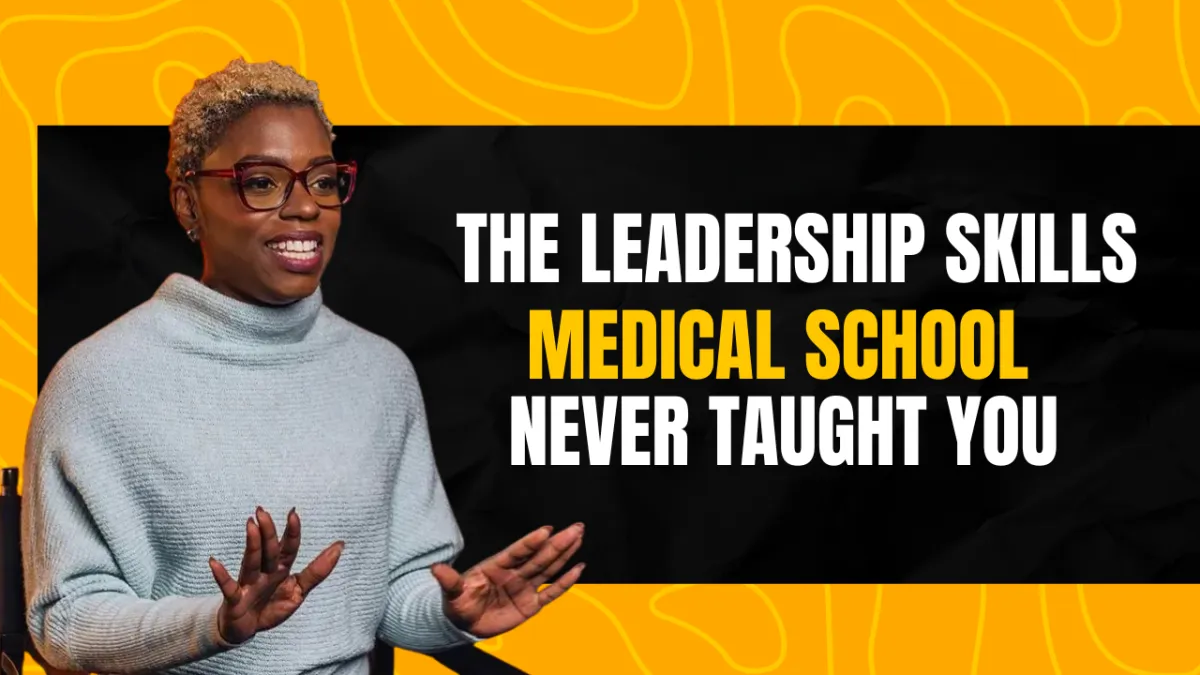
The Leadership Skills Medical School Never Taught You
Medical education is one of the most rigorous training systems in the world. It teaches anatomy, physiology, pharmacology, diagnosis, clinical reasoning, and procedural excellence.
But after nearly two decades in medicine and years serving in physician leadership, I've realized something remarkable: very little of our education prepares us to lead people.
What Medical Education Left Out
Despite years of intense preparation, key leadership competencies are routinely omitted from traditional medical training:
Navigating Conflict: No one teaches physicians how to resolve friction between colleagues.
Influencing Executives: No one teaches us how to drive change without formal authority.
Delivering Feedback: No one teaches us how to deliver constructive feedback to high-performing peers.
Navigating Politics: No one teaches us how to manage organizational politics while maintaining absolute integrity.
Inspiring Teams: No one teaches us how to motivate and guide teams during periods of extreme uncertainty.
Yet these are the exact skills that determine whether physicians succeed as leaders.
Why Leadership Is No Longer Optional
Healthcare is becoming increasingly complex. To adapt, the industry needs a new breed of leadership:
Healthcare Organizations need physician leaders who can bridge clinical excellence with strategic thinking.
Patients need physicians who can improve entire systems, not just individual encounters.
Communities need leaders who deeply understand both medicine and people.
Key Takeaway: Leadership development should never be viewed as a luxury—it should be viewed as an essential clinical competency.
Applying Your Strengths in a New Way
Every physician already possesses qualities that make outstanding leadership possible:
Integrity
Discipline
Commitment
Compassion
Resilience
Those strengths simply need a new framework. Leadership is less about becoming someone different and more about learning how to apply the gifts you already possess in new ways.
Expanding Your Impact Beyond Clinical Care
When physicians develop influence alongside expertise, their impact extends far beyond the patients they personally treat. They begin:
Shaping cultures
Improving organizations
Mentoring future physicians
Creating healthier healthcare systems
That is the kind of leadership our profession desperately needs. And it begins with one single decision:
To grow beyond clinical excellence into leadership excellence.
